
The Hidden Cost of a Missed Call: How AI Voice Agents Are Changing Auto Service Booking
An industry built on phones that keep ringing
Walk into almost any independent auto service center, franchise location, or multi-bay repair shop during a normal business day, and you’ll find the same scene: a service advisor juggling a customer at the counter, a technician asking a question about a part, and a phone ringing in the background that nobody has time to answer.
That ringing phone represents something the industry has quietly accepted as a cost of doing business: the missed call. A customer with a check engine light on, a brake job to schedule, or an oil change overdue calls in, gets voicemail or a busy signal, and simply calls the next shop on the list. There’s no follow-up, no lost-lead report, no visibility into what just walked out the door. It’s revenue that never shows up as a number anywhere, because it never became a booking in the first place.
Add to that the calls that come in after hours, when the shop is closed but the customer’s problem isn’t waiting for business hours to happen. Add the calls where a customer describes their issue in plain, everyday language (“my brakes are making a weird noise” rather than “I’d like to book a brake pad replacement”) and the person answering has to translate that into the right service, the right price, and the right slot on a schedule that’s already juggling limited bays and technician availability. Add the very real risk of double-booking a bay, or promising a slot that quietly conflicts with something already on the calendar.
None of this is a new problem. It’s the everyday friction of running a service business with finite front-desk capacity and a phone that doesn’t stop.
Why this problem resists the obvious fixes
The instinct is usually to hire more front-desk staff, or route overflow calls to an answering service. Both come with real limitations. More staff means more payroll for a role that’s fundamentally reactive, present specifically to catch calls that happen to come in during business hours. Traditional answering services solve the “someone picks up” problem, but not the “someone who actually understands the business, the schedule, and the services well enough to book correctly” problem. A human answering service operator, unfamiliar with a specific shop’s bay capacity, service menu, and pricing, tends to fall back on “let me take a message and have someone call you back”, which reintroduces the exact delay that loses the customer in the first place.
What the industry has actually needed is something that combines the availability of a 24/7 answering service with the actual booking competence of a trained, in-house service advisor, at a cost structure that makes sense for a single location, not just a large multi-site chain.
How Call Connect AI approaches automotive service booking
Call Connect AI’s automotive booking module is built around a simple premise: every call should be answered, every call should be handled by something that actually understands the business, and every booking should be as accurate as if a well-trained human had taken it.
Always-on availability. The AI voice agent answers every call, every time, regardless of the hour. A customer calling at 9pm about a dead battery gets the same competent handling as one calling at 10am on a Tuesday. No voicemail, no “we’re currently closed, please call back”, no lost lead.
Natural conversation, not a phone tree. Callers speak to the agent the way they’d speak to a person: describing their car, their problem, and when they’re free, in their own words. There’s no “press 1 for service, press 2 for parts.” The agent listens, understands intent from natural phrasing, and asks clarifying questions only when genuinely needed, the same way a good service advisor would.
Real-time schedule awareness. The agent checks live availability against actual bay and technician capacity before confirming anything, so a customer is never told a slot is open when it isn’t. If a specific time is already booked, the agent offers the next genuinely available option immediately, in the same conversation, rather than promising something that later has to be walked back with an apologetic follow-up call.

Accurate service matching, even with everyday language. Customers rarely describe what they need in the exact terminology a shop’s internal service menu uses. The agent is built to bridge that gap, recognising that “my car’s shaking when I brake” or “I need my oil done” maps to a specific, correctly priced service on the shop’s actual menu, not just a generic catch-all booking that has to be sorted out later.

A personal touch, automatically. The agent naturally picks up on a caller’s name early in the conversation, the way a person introducing themselves at the start of a call would expect, and uses it naturally through the rest of the interaction, including at the point of confirming the booking. If a caller doesn’t offer their name unprompted, the agent asks once, briefly, without turning the call into an interrogation. It’s a small detail, but it’s the difference between a booking experience that feels transactional and one that feels like the shop actually knows who’s calling.
A safety net beyond the obvious. Vehicle registration numbers, spoken aloud over a phone line, are notoriously easy to mishear, whether by a human or a machine. Capturing the caller’s name alongside the registration gives the shop a second, reliable way to identify a booking and follow up with a customer even in the rare case a registration gets garbled in transcription.
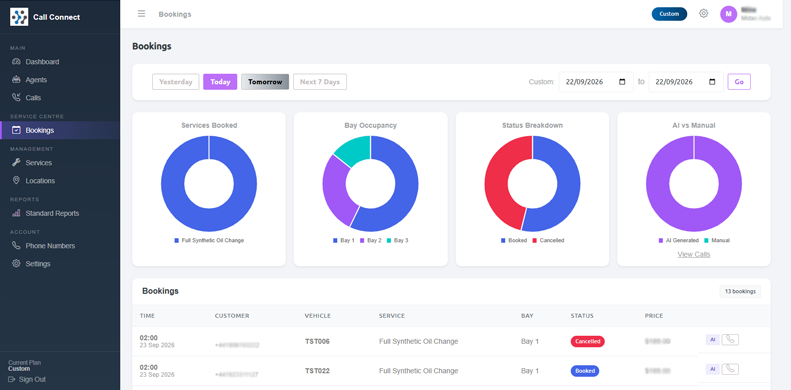
Visibility for the business, not just the customer. Every call, every booking, and every outcome flows into a live dashboard the shop owner or manager can actually see: how many calls came in, how many turned into bookings, what services are being requested most, and what’s on the calendar for the days ahead. The phone stops being a black box and starts being a measurable part of the business.
What this actually changes for a service business
The shift isn’t just “the phone gets answered.” It’s that answering the phone stops being something that competes for a staff member’s attention against everything else happening on the shop floor. Every call becomes a potential booking handled competently and consistently, whether it’s the first call of the day or the fortieth, whether it’s 9am or 9pm.
For an industry where a single missed call can mean a lost customer who simply moves on to the next name in a search result, that’s not a minor operational tweak. It’s closing the exact gap where revenue has quietly been leaking out for as long as shops have had ringing phones and finite hands to answer them.